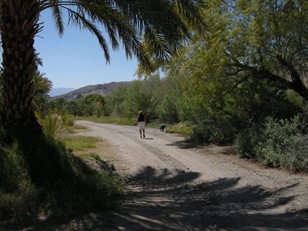
Fall Sunset from the Deck

Fall Sunset from the Deck
Showing posts with label Turkey. Show all posts

Monday, April 4, 2011

Pahrump, Shoshone, and the China Ranch

no more saguaros, now Joshua trees and smell the sage! The drive from Laughlin up the hill to Highway 95 toward Vegas is steep, but not really very long and we rolled up the hill in the morning sunlight.  Another possible stop on our route was Boulder City, where a soil scientist friend had promised a cold drink and a copy of his presentation on the Spirit Mountains.  Again, it was not to be.  I only heard about the RV search at Hoover Dam after we had already decided to re-route around Las Vegas traffic as much as possible and skip the drive across the new bridge at the dam.
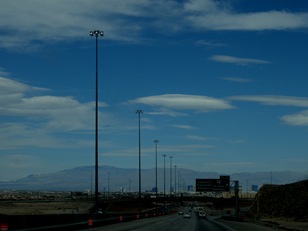
toward Las Vegas The drive to Pahrump was short, just under 160 miles, and the road was great.  We managed to skirt the worst of the Las Vegas traffic on the south side of the city, staring in awe at the miles and miles of low brown stucco homes covering the desert.  Highway 160, west from Las Vegas, is part of the Old Spanish Trail and winds through the Red Rock Canyon National Conservation Area and crosses the beautiful Spirit Mountains at Mountain Springs.  Once through the pass, the wide desert vista of the Pahrump Valley opens up to the west. As Mo drove the smooth, even highway, I started checking out the Streets and Trips listings of Camp Club USA parks in Pahrump.  We called a couple of places, discovering that once again, no one had cable, but the Charleston Peak Winery RV Park was on our list, and had an opening for our club, 1/2 price at 20 bucks once more.

Laughlin to Pahrump (30) There are many RV parks in the area, and we toured around town checking them out the next day, but still were happy with our choice, especially at the price.  Once settled in on the high fan above town, with an unbroken view of Charleston Peak to the east, we were especially tickled.  The swimming pool was closed for the evening, but it was just a few hundred yards to the tasting room at the “only” or “first” winery in Nevada.  I am still not sure which, but I suppose I could look that up eventually.  The winery said one thing and the chamber said another, so which is true?.

sunset on Charleston Peak Seven tastings are offered for free, and even though they no longer grow their own grapes except for a very small vineyard, they made some award winning cabernet from Sonoma grapes. The original vineyards planted were destroyed a few years ago by wild horses.  Mo stayed with Abby and I enjoyed sitting in the unpretentious, intimate little tasting room with award winning wine while Mo settled for a glass of chardonnay in the MoHo. 

Laughlin to Pahrump (50) The evening was much cooler than any we have experienced in a couple of weeks, with a wild, blustery wind blowing across the desert.  I’m not quite sure why, but even in that wind our slide topper didn’t seem to flap too much.  Maybe it’s a different kind of construction than some.  So  far it hasn’t been a problem. Charleston Peak was brilliant snowy white against the dark cloudy skies to the east, with the western skies clear enough for a gorgeous sunset.

today's explorations Sunday was our day to relax and explore more of the area south and west of Pahrump.  When we traveled to Death Valley in 2004, we had a rented car, (pre MoHo days!) and spent a lot of time exploring the park.  It was time for something different, and with the help of the excellent Discover Pahrump brochure, we mapped out a route.

West of Pahrump, Highway 372 changes to 178 when you cross into California, crossing a small range of mountains and opening up to another valley.  The tiny community of Shoshone lies in the heart of the valley, a pleasant stop for folks traveling farther west or north into Death Valley.  It was a nice stop for us as well, and with the price of gas, we were glad we had filled up the tracker back in Nevada and a mere 3.69 per gallon.  Shoshone is full of crusty characters, and has a history of fascinating people.  The museum there is tiny, but wonderful, with a special section devoted to Death Valley Women, with photos, newspaper articles, and stories.  In the back of the museum are the collection of bones once thought to be mammoth bones, but later identified as several different animals probably washed into the Pleistocene lake from several different areas.

remnants of a different era in Shoshone, CAShoshone lies at the edge of the ancient lake, and the area is riddled with soft sediments from the old lake bed, then uplifted and eroded into washes and gorges and mesas, surrounded by more wild volcanics, ash flow tuffs, and even obsidian. Suddenly in the cliffs, we saw caves that were obviously man made, and got out to explore.  Later, the museum volunteer pointed me up a  dirt road west of Shoshone to view more of these man made caves.  Near town, in addition to a very strange and wacky looking cemetery, we found what was left of hand carved homes inhabited by desert dwellers in the 20’s and 30’s.  They looked ever so much like homes carved out of the volcanic tuffs in the Cappadocia region in Turkey.  Certainly not as old, and not as artistic, but the idea was the same.  Carve out a safe home, warm in winter, cool in summer, using what is available.

apartments in the desert Apartments carved in stone in the desert near Shoshone, maybe a little over 80 years old?

click here for many more photos of the area around Shoshone and the cave homes.
DSCN8382 Apartments carved in stone in Cappadocia, maybe over 1200 years old? 

Click here for more photos of the fantastic home in the Cappadoccia region of Turkey

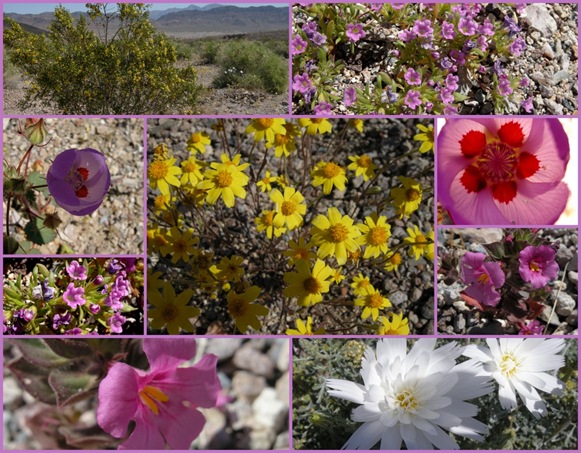
After exploring the cave apartments, we continued up the wash toward the volcanic hills.  The road ended after a few miles, but yielded a wonderful array of blooming wildflowers.

Yes, Mo and I did plenty of tent camping before we got the first MoHo in 2005

P1010019 Back on the highway, we continued south toward the small community of Tecopa, site of several hot springs resorts.  I say “resort” with tongue in cheek, because these places were not fancy in the least, just dusty campgrounds with faded signs that said “hot mineral baths” or “massage”. The springs are known for their healing properties, and have been used by humans for centuries, but they didn’t look all that tempting to me.  My favorite spring is still up in the mountains of eastern Oregon, in the middle of a meadow at Hart Mountain.  But that’s another story, prior to MoHo days, when Mo and I tent camped up there.

Road to China Date Farm Beyond Tecopa to the south and east on the Spanish Trail, is the desert oasis of China Ranch. The road into the valley is twisting and winds between fantastical apparitions of the badlands.  Once through the tiny canyon, the small valley opens up, green and lush with date palms and irrigation.  It wasn’t very clear about where to go, and we followed a dirt road and a sign that pointed to the gift shop.  The parking lot was almost full, but the gift shop was very small and didn’t seem to be near the date palms at all.  There were a few signs pointing to the river, but we really had no idea where to go, and of course with Abby, we needed to check on the dog friendly areas, if they existed.

nice walk on a hot day I went into the tiny, crowded gift shop, where one person was busy making date shakes, and no one else seemed to be around.  I finally asked a customer if they had any idea of what you were supposed to do in this place and she gave me the 50 cent trail brochure.  Ahha!!  No restrictions on dogs!  We didn’t even see a leash sign, but kept Abby on her leash anyway.  The maps on the brochure were fairly primitive, and even as a map maker I had a hard time figuring out where to go.  We ambled up the lane toward the date palms, trying to find a circular route which eluded us, and trying to avoid the hot badlands which didn’t sound all that great on this hot mid afternoon.

Shoshone and Tecopa (79) The palms were beautiful, graceful and gentle in the desert.  Each variety had an informative sign explaining it’s origin, something we had seen at the Oasis in Indio, but of course here everything was much more rustic and casual.  After hiking an hour or so, we walked back to the shop for a cold drink.  I kept thinking I wanted a date shake, but every time I would slip inside the line was too long, and the poor guy was still doing everything by himself.  Mo and I settled for a cold diet pepsi and some time on the shady bench outside the store.

Our trip home followed the original path of the Old Spanish Trail back to Highway 160 south of Pahrump.  There are great signs about the trail in two places, but each of them comes up suddenly with no warning, so you have to be ready to whip in or turn around to read them. It was sobering to stand in that wide open, hot, dry desert basin, with range after range of rugged mountains in every direction and envision hardy travelers following this path from Abiquiu, New Mexico to Los Angeles in 1829.   John C Fremont, another hero of mine, passed on this trail in 1844.  In 2002 it was designated by Congress as a National Historic Trail.  Our circular route back to Pahrump followed much of this path, and even I-15 follows along the historic trail for some distance in Nevada.

Charleston Peak east of Pahrump in the distanceOnce home again in the late afternoon, we settled in to reading and relaxing before our planned outing to the Pahrump Nugget Steakhouse for their highly touted best steaks around.  Sometimes Mo and I skip lunch entirely and eat a very early supper, but again, this time we were considering Abby and our opportunity to eat out required dark night skies. The casino was fairly quiet on a Sunday night, but the restaurant was full to the brim with a big bunch of bikers who were staying in a nearby hotel.  At first we though the whole idea might have been a mistake when the waitress said there would be an hour wait.  The restaurant didn’t even look full, but all the wait staff was in the back room with the bikers.  We said we would be happy to sit in the bar, actually just a couple of tables next to the restaurant, and settled in to watch all the frustration of the employees trying to deal with a lot of people with not a lot of staff.  Finally we managed to get a couple glasses of wine and then a sweet young man, who turned out to be the off duty chef, came over and took our order.  Once they figured out that someone needed to wait on us, everything went great.  My steak was perfect, and I have 3/4 of it left for our dinner tonight..  Once back home, we felt like it was a perfectly lovely day and we were ready to settle in to the slight evening breeze. 
Apr 3 Shoshone and Tecopa Our trip is coming to a close.  As I was writing this entry, the wild crest of the Sierra Nevada Mountains opened up to the west, and the snow capped ranges of western Nevada are framing my view to the north as we approach Walker Lake.  Not sure yet where we will stop tonight, but I do hope it is on a big alluvial fan somewhere in the Nevada desert, with a view for miles and no lights to be seen.

Friday, December 5, 2008

Day 15 Returning Home

Time is really a weird concept when you are flying around the world. While in Turkey, I could keep track of what time it was at home so I didn’t call the kids at 2am, and what time it was where I was. But at the moment I am flying in an airplane that is traveling west at something like half the speed of the planet and time makes no sense whatsoever. I just know that it is passing. We are over Greenland, and the sky is dark except for a thin red line on the southern horizon outside my window. According to Mo’s watch, it is 10:00 AM in San Francisco, and we will land there at 5:00PM this afternoon. We left Frankfurt at 4 in the afternoon, same day, and yet time is passing. I am not sure why it is night here, because it isn’t even nighttime here according to the time zone we are supposedly in, but I guess we are so far north that at this time of year it is always night anyway. It’s all crazy.

At 4am this morning, Istanbul was vibrant with street life. We rode the bus through the city to the airport amazed at all the activities going on there. People coming out of bars, standing on corners, buying cigarettes and groceries, doing the Turkish man thing of standing around shooting the breeze. Except it was 4am. Amazing.

I fell in love with Germany today, somewhere between Switzerland and Munich. The Alps were covered with snow and the plains around Munich are like something in a fairy tale. The fields are still green, and a magical patchwork of angles of varying shades of green, with patches of dark forest, dotted with perfect little villages of white with red roofs. The roads looked nearly empty, with traffic moving along the major highways smoothly. The sunlight was coming over the magnificent snow covered mountains to the south and angled across the green fields and forests in a way that made me think of what life must be like in a small German village, and suddenly I wanted very badly to experience Germany.

The airport at Munich was clean and full of bustling activity, with great shops and clothes and wonderful smelling food. It made me laugh at how I felt about Germany at the beginning of this trip and it made Mo happy that I decided I really liked Germany after all. She has many happy memories of traveling in this country. I hope I get to do that someday. Guess it’s a good thing that I am learning to drink beer.

Now the red line changed to a deep deep blue, and in a matter of moments back to the faintest hint of orange again. Maybe we are going towards some kind of daylight?

The trip is very nearly over, the final travels are ending, and the integration of all I learned and experienced is waiting in the wings. I am sure that more will come to me, the deeper part of Turkey as a cradle of civilization in the world, and the blessing of traveling to a place never thought of much and learning about it in a way you can never do without being there. This fluorescent thin blue line on the dark horizon is a great symbol of the end of this trip. Too bad I can’t take a picture of it. I guess it’s another one of those experiences that can’t be caught and just has to be felt.

Later at home:
I am discovering some of the things that I appreciate much more after traveling in a foreign country! toilet paper, light bulbs that are actually bright enough to see, electricity that works steadily all the time, lots of clean clothes to choose from, good brewed coffee, not Turkish and not NesCafe! and the ability to buy aspirin or cough drops at the grocery store without having to find a pharmacy!

Thursday, December 4, 2008

Day 14 returning to Istanbul

http://picasaweb.google.com/kyotesue/Day14LastDayInTurkey#


Some of the people on the tour decided to do the ballooning over Cappadocia thing this morning, so when I looked out the window and saw sunny if frosty skies I was glad for them. I couldn’t see the worth of 30 minutes in a very cold balloon over that brown landscape for 150 USD so decided that having a relaxing morning was the best plan. Especially since this day included our afternoon flight to Istanbul.

We left the hotel at 9:30 and Mo and I opted out of an underground city tour and instead sat by a warm fire and drank Turkish tea, and then did a little bit of last day shopping in a small village. Lunch was back in the town at a different restaurant, and turned out to be the best yet. Finally, after 2 weeks in Turkey, I found the manti Jeanne told me about. Perfect little pasta dumplings with some meat filling swimming in a tangy yogurt tomato sauce, with big puffy breads. Yum.

After lunch we took our time driving to the airport in Kayseri, and saw how dismal this central part of Turkey can be. Once you leave the chimneys and mountain views, things get very polluted, gray and old looking. The air was dark with coal smoke and haze and there was a lot of garbage around and very tattered looking apartments. This part of Turkey looked more like what I imagine this part of the world to look like, unlike the Turkey we have seen up until now.

The flight to Istanbul on the Turkish Airlines was smooth and lovely, with a gorgeous sunset. As I watched the Black Sea and the lights of Istanbul appear in the dark I realized how truly lucky I was to have been in this country. Later, after landing at the clean, efficient Attaturk airport, we loaded back into a different bus with a different driver and headed for the Lion Hotel in the Taksim Square section of town.

I realized also just how much I loved Istanbul. In the dark, all the mosques were lit and shining against the sky, of course you could see the Blue Mosque and the Suleyman Mosque, but there are so many others. The city is beautiful and rich and full of antiquities and energy. The water of the Bosphorus and the Golden Horn reflected all the lights as we wound through the hills to get to our hotel. Istanbul is such a wonderful city, I could spend time there just exploring it’s rich history and culture and hidden streets. There was so much there that we didn’t see in our short visit, but on the way through the city for the last time, I really wished for more.

Our room at the Lion this time was higher and more open, and I decided that indeed it wasn’t the worst hotel on the trip. We had a view of the city lights this time, and in our short sleep time before the 3am wakeup call we were serenaded through the open window by the busy night street life going on below us.

Wednesday, December 3, 2008

Day 13 Cappadocia and the Goreme Open Air Museum

http://picasaweb.google.com/kyotesue/Day13Cappadocia#


Today was the first day since I have been in this country that I didn't see it as similar to somewhere else I have been back in the US. Today, Turkey was only Turkey, Turkiye' as it is called here. Today we woke to fog in Urgup, in the central part of the Cappadocia region, but by the time we began our explorations, the fog began to lift. This place is surreal, like no other. I know I am behind, it is midnight right now after a day that started at 6am, and no, I haven't had time to keep up with the stories. But I do have the photos, and the stories will have to fill in later. For now, just check out this magical landscape and these amazing chapels in the carved out caves of Cappadocia.
Ten million years ago, volcanic eruptions from Mt. Erciyes and Mt. Hasan blanketed this limestone plateau in central Turkey with ash and lava. When they mixed with water, the result was a mud-like substance that slowly hardened into a soft rock called tufa or here in the west we call it tuff.

Centuries of erosion from rain, wind, and flooding from the Kizilirmak River shaped this tufa into a striking, surreal moonscape of cone-shaped pinnacles and towers, all in a variety of lovely hues. One of the region's most unusual geological features, the peribacalari (fairy chimneys), formed when boulders of hard basalt trapped on the surface shielded the soft underlying tufa from erosion.

The holy grottoes of Cappadocia once housed the largest community of Christian monks in Asia Minor. From here missionaries spread the Christian faith as far as Ethiopia. Some 300 beautifully frescoed churches and dwellings for 30,000 people were carved from the soft volcanic pinnacles between the 4th and 14th centuries. I was awestruck by the maze of cones, windows, and chimneys built directly into the malleable rock. Beneath these fanciful shapes lie even more wonders—underground chambers, even entire villages, some 14 stories deep!

Residents fashioned bedrooms, churches, and storerooms from the rock, connecting it all with an elaborate labyrinth of passageways. We saw a host of churches carved more than 1,300 years ago, still boasting lovely frescoes. Some of the houses remain occupied today, and some of the ancient storehouses still provide shelter for grapes harvested from local vineyards.
Waking up in the Perissia Hotel was a delight, even though the morning was foggy. This was my favorite hotel, even though it wasn’t as new or as fancy as the suite we had it Antalya, it was charming and roomy, with pale lemon colored walls with rose accents, lots of windows with dark mahogany woodwork, and antique porcelain fixtures. We could see the dry brown landscape of Cappadocia through the fog, but had no real clue as to the wonders that awaited us on this day.

I have seen photos of this place, read a lot about it, looked at websites describing it, but again there is nothing that can really begin to describe what it feels like to be in a world of houses carved out of rock. It’s like some kind of fairy land, or something you might have dreamed once. It is the reason why travel can never be replaced by writing or talking or looking at the pictures. You just have to be there.

We explored the Pigeon Valley, and took photos of some of the amazing shapes formed by the erosion of the volcanic tuff with the volcano that made all this ash looming above the landscape. As the fog cleared we made several stops at viewpoints a long the way for short hikes and more photos, and for some of us, more jewelry shopping. Then on to Goreme’, the outdoor museum of churches and chapels that were carved into the stone. The caves have existed for a few thousand years, but in the time between the 6th and 13th century they were used as chapels for the early Christian church. The paintings from the earlier periods are primitive, mainly done in a terra cotta red, but as the caves became more sophisticated, the art developed as well, and the Byzantine and Iconoclastic frescoes painted in the interiors of these caves was incredible.

I have said this before, but again I am discovering why I am not a professional travel writer. I am completely out of adjectives. This trip has drained my skills completely dry. I walk around trying to remember to keep my jaw from dropping all the time, and just am at a loss for words. Cappadocia has to be experienced. Nothing else will do.

We had a decent supper in the hotel before going out in the evening to a remote location where a large restaurant was carved into the rock, mainly for the tourist busses I am sure, but it was still fun. The folklore show was interesting, but because there were so many visitors from so many countries there weren't any kind of announcements about where the different dances were from, which was a bit disappointing. The men were the stars of the show in this case, with some amazing feats of dancing, including that Russian looking thing where they kick their feet out from a sitting position. I still don’t know for sure if that is really a Turkish thing or a Russion thing. The women were demure and certainly outdone my the men in these traditional dances, but they did perform one tribal belly dance that was fun because I knew all the moves from my belly dancing days. Later in the evening we had a cabaret style Egyptian belly dancer who was really quite good, with some top notch shimmies and belly rolls. She wore very high heels though, which was also a bit strange, but I guess it’s to please the men.

We ended this long day winding in the very dark landscape in a very big bus with a bunch of tired people back to the hotel via some weird short cut. Getting in after midnight made us really glad that the next day was going to be a late one.

Tuesday, December 2, 2008

Day 12 Antalya to Urgup over the Taurus Mountains again

http://picasaweb.google.com/kyotesue/Day12OverTheTaurusMountainsToUgurp#


Our day began with the call to prayer in the dark over Antalya. It was to be an early day since we were traveling a long distance over the Taurus Mountains to the Cappadocia Region. For a long time after we left the city, I had great knitting time, with long wide 4 lane highways going through a rich agricultural landscape that looked a lot like Southern California, wide valley surrounded by mountains and bordered by the sea. I am beginning to think of my knitting project as my “turkey sweater” and I’m becoming very fond of it as I knit along the roads watching the scenery. It really does make the miles flow along when things are less than exciting.

Crossing the Taurus Mountains was gorgeous, and we were especially lucky since Suleyman told us that often on this tour the mountains have snow and sometimes the bus has to chain up. Not a fun thought, and today as we drove through brilliant sunlight I was especially appreciative.

Note to self: always always always bring the extra long lasting batteries from the US for the camera, the ones I pay 10 bucks for 4 usually last at least a few days in my camera. I ran out, and sure enough, the 5 Lira batteries that said they were extra long lasting digital batteries blew out after a couple of photos. Not a good thing. I did know better, but didn’t plan properly. I think I have spent a large part of my petty cash on batteries now!

We drove over the pass at more than 6000 feet elevation and headed down toward the city of Konya and the Konya Plain. Our one stop for this long travel day was the museum in Konya where the famous Sufi mystic, originator, and poet Mavlana Rumi is entombed. As we rode along in the bus, Suleyman treated us to folk stories of Hoagi, a mythical character somewhat like Coyote, and the story of Rumi and the Whirling Dervishes. My friend Shera loved Rumi, and when I first met her, she introduced me to some of the Sufi mystical concepts, but I somehow never quite put it all together, Islam, Sufism, Rumi, and the Dervishes. Now with Suleyman’s help it is all coming together. In fact tonight, a bit later, we will be going to see the whirling ritual, something that means a lot more to me after hearing Suleyman’s explanation of the whole thing.

Mevlana Rumi was a Turk born in Afghanistan in the early 13th century. The poetry of Rumi is considered to be the second most important piece of literature in the Islamic world next to the Koran.


In this mystical tradition, they believe that all humans are created by god and we each keep a piece of God within us, but we have been separated from this godlike nature by living in the world. Sound familiar? The spiritual goal is that one should try to get rid of all distractions and be reunited with God. Interesting tidbit, in Islam there are 90 different adjectives for Allah, God, and looking at something beautiful is a way to appreciate God.

There is a flute made of reeds called the Ney that the Dervishes use in their rituals. According to tradition Reed says “Once I was growing in the marsh. I was alive I was connected with my roots to the earth, but someone came and cut me off so I was separated the way the human beings got separated from the One. This is the reason I am mourning, why my sound is so sad.”

The whirling dervish order is one of hundreds of different orders within Islam. In Islam there a many paths to find the truth, and one has the choice to follow any of the many different paths and still be a good Muslim. Mavlana Rumi was a mystic and a teacher and was the first one who whirled.

The white costume represents the shroud and the tall red fez represents the tombstone, one hand open to the skies and the other hand down, receiving from god, and giving to others. To the question “why do you whirl?” The answer is that many religions have a method to get rid of all distractions, a form of centering or meditation and prayer. The Dervishes know that everything whirls, the world spins, the microcosmos spins, electrons whirl, water whirls in the sink. To them, whirling is being in harmony with the world.

There is no translation in English for the word Dervish, although “monk” is similar, but dervishes can marry and lead normal lives. The closest translation for the Tekke is monestary. Once admitted to the tekke, the task for the initiate was to try to learn the secret. The elders ask tricky questions in order to find out if you have light within you or not. Some people have the light and others don’t. In the first couple of years you are treated very badly, if you make it you move to the second step. You learn the Koran, then the different philosophical approaches to the Koran. Finally, if you have the light and are worthy, you attain the 7th step where you then learn the truth, the secret.

Usually this secret isn’t divulged but Suleyman says he has a Dervish friend who told him that the Secret was to say, “I am God”.

After Attaturk formed the secular state in 1923, all the Tekke’s were outlawed, even the whirling dervishes. Now they are here in the name of cultural associations, and supposedly they are no longer a religious sect or order because of the secular requirements for Turkey. Today we saw the tomb of Mavlana, a holy place that is now just a museum, with many manuscripts and also Mohammed’s beard in a box. Ha.

Monday, December 1, 2008

Day 11 Phaselis, Aspendos, and Perga

http://picasaweb.google.com/kyotesue/Day11PhaselisAspendosAndPerga

When we first arrived last night at the Khan Hotel in Antalya, our initial thought was to skip all extra trips and spend time right in town, exploring the city and hanging out in our wonderful suite with the view. But we also wanted to actually see the place, Perga, where the amazing sculptures came from, so we signed up for the extra afternoon tour of Aspendos and Perga.
The morning was gorgeous, clear and beautiful with sunlight on the Bey Mountains (part of the Taurus Range) to the west and we knew it would be a great day to be traveling along the Mediterranean. After our standard breakfast of olives, bread, cheese, yogurt and honey for me and hard boiled egg and cereal for Mo, we boarded the bus for the drive west along the coast. Antalya is interesting in that it really is a fairly new city in spite of the ancient history of the Old Town portion and the innumerable ruins from the Hellenistic and Roman periods that surround the city in both directions. Most of the buildings in the major part of town however, are dated from the 50’s when western tourists discovered the magnificent climate, beautiful seas and beaches, and mountains. It makes for a rather boring city with canyons of cement cubes and streets without much character, especially compared to the creative chaos of Istanbul.
As we drove west along the beaches the mountains loomed up larger than life, with huge cliffs dropping right to the Mediterranean.
Approaching our first ruin of the day, the ancient Lycian town of Phaselis, we drove through thick forests of red pine with wide vistas of the sea and mountains, and open roads with no traffic, which was especially nice since they came close to the HWY 1 roads along the Big Sur coast of California.
Phaselis was established by the Greeks from the island of Rhodes as early as the 7th century, fell to the Persians and then later to Alexander the Great after he defeated the Persions. The city was in Egyptian hands for a short time, but after 160 BCE it became part of the Lycian culture that was actually under Roman rule. Because of its 3 beautiful harbors, rich timber resources, and fresh water sources it was a target for pirates repeatedly throughout its history, with losses during the Byzantine period and then as late as the 11th century when it ceased to be an important port and eventually vanished entirely.

The ruins themselves are not especially exciting, a great remnant of a Roman aqueduct, some large baths, and a truly beautiful theater are the standouts, but the setting is probably the most beautiful in all of Turkey. The harbors are especially gorgeous, with crystal water, sandy and rocky beaches surrounded by forests and Mt Olympus, one of 22 such named mountains in Greece and Turkey, rising to more than 7,000 feet above the sea.

Our visit was leisurely, with time to put our feet in the Mediterranean, hike up to the top of the theater, and take lots of photos of the amazing mountains and lovely forest. It was warm and sunny, and one of only two capri days for Mo and I on our trip. Interesting tidbit regarding the decline of the city had to do with the fresh water marshes that still exist nearby. Malaria was one of the scourges of this lovely climate by the sea with plenty of fresh water, so between pirates and illness it faded away into history.

Winding our way back along the coast and to Antalya, we were conflicted in our choice to go on the afternoon tour and at the last moment I very nearly jumped the bus in order to have time to explore the bustling city and wander the streets in freedom. Glad we didn’t do that, however, because our visit to the Roman theater at Aspendos was one of the highlights of Antalya. Aspendos was the eastern most city of the kingdom of Pergamon, the culture responsible for the gorgeous city on top the hill near Kusadasi that we saw on Day 6. This Roman amphitheater was built in AD 162 and is the most beautifully preserved Roman theater in the world. I climbed to the top of the theater, walking the gallery, and imagined the beautiful façade that once held many of the sculptures that we saw yesterday in the museum. Some people from the group sang for us to demonstrate the amazing acoustics, although I really wished my daughter Melody could have been the one singing there for me. I also took photos of the backstage area and how it looked to walk backstage onto the main stage with that huge arena in front of you. The Helenistic period was dominate by theater, comedies and tragedies, and it wasn’t until the Romans that these theaters became a venue for beast fights and gladiators. There were remnants of the fences that separated spectators from the animals, and the gaping hole where the lions emerged was impressive. We both really loved this theater and were glad we didn’t miss it.
The trip to Perga very late in the day was somewhat of an anticlimax, with ruins not as impressive as Ephesus, or as well preserved. There are ongoing archaeological digs that were interesting, and there is still so much to be explored. After seeing all the artifacts from this place in the museum, and looking at all the mounds surrounding the area, it is great imagining what waits to be found here.
We returned home after dark, somewhat sad that we had no time to explore the city of Antalya much, but still managed a walk through the pedestrian mall down to the sea wall and the bazaar that bordered the old city and the sea. It was pretty quiet, with many of the summer tourist restaurants closed and dark, but still lots of younger people walking about and again the standard groups of young Turkish men hanging around smoking and talking. There really weren’t many women about, but the presence of some young couples walking the promenade and the general respectful nature of the Turkish men gave us a reasonable sense of safety even in the dark evening. Still, I didn’t carry a handbag, used a clip to hook my wallet inside my pocket, and kept my hand on it the entire time. Although Suleyman warned us about the few people who might be less than honest, we never had any problems the entire time we were in the country, for which I am grateful. There was nothing of the pushing and shoving and invasion of personal space that Mo experienced in Morocco which I had expected might be a problem. The men in Turkey that we encountered were invariably charming, and entertaining, but the women were guarded and not the least bit inclined to be taken in by western tourists. Much like cats, the boys are all friendly and outgoing and the girls hang back and look at you with caution. I found this very different from Thailand where the women are incredibly sweet and kind and treated us with great friendliness.

Sunday, November 30, 2008

Day 10 Traveling through the mountains to Antalya

http://picasaweb.google.com/kyotesue/30NovOverTheTarsusMountainsToAntalya#

I did some research before we left for this trip, so I did know that parts of Turkey were mountainous. Nothing quite prepared me for what we saw today, and from what our guide says, this is only the beginnning. We left Pamukkale in more dreary weather, with snow capping the peaks surrounding the Meander Valley. Our climb from very nearly sea level to more than 5000 feet elevation as we wound up and down the mountains was dramatic, and unexpected, to say the least. I spent most of the morning with my mouth hanging open. There was so much to see, and again, the downside of traveling by bus is very evident in my photos full of reflections of the window glass. Tour bus drivers aren't too keen on stopping for photo ops, but the mountains were so dramatic I had to take photos anyway. I apologize for the quality, but still wanted to share the magnificent views of the Taurus Mountains.
The shifting geology kept me enthralled and glued to the window. We climbing from my California looking landscape, right up into a wild volcanic lanscape that rivaled anything in Oregon, and crossed incredibly flat and fertile valleys filled with deep dark alluvial soils. All the crops have been harvested by now, but the richness of the land is evident everywhere. The volcanics shifted abruptly to limestone and marble, with huge marble quarries along the foothills. Some areas had solid limestone rock outcrop surfaces that were probably 90 percent rock and maybe 10 percent soil.

We stopped for tea and bathrooms at a Urok shop where the women were still wearing traditional Urok pantaloons and selling pomegranate and orange juice fresh squeezed. Once we dropped down from the mountains, and began the approach to Antalya, another sub range of the Taurus mountains loomed to the west. These mountains, rising directly from the Mediterranean, are so dramatic that they look like something made up and painted against the horizon. The city of Antalya is one of the most ancient in the world, and the ruins and archeaological finds are everywhere.

We stopped at a huge mall for lunch and another break where everything was as cosmopolitan as anything in the west, and people were shopping and spending as if there wasn't a recession in sight. The mall had a huge food court with Turkish food and all the American versions of fast food as well. Leaving the mall was a challenge since our bus was so huge and once more there wasn't enough room with all the traffic coming and going. For a bit, we thought it was going to come to a real fight between our bus driver and another man who refused to move his car, but it all ended well with our great big bus once more negotiating impossible turns and narrow spaces.
The visit to the archeological museum was breathtaking. Truly so. Most of the sculptures there were from the ancient city of Perga, another ruin we will be visiting tomorrow, but seeing them here was wonderful because they were presented so beautifully, and were all in a place where you could actually appreciate their magnificence. I am in awe of the wonder of sculpture, this kind of sculpture, in stone, chipping away. It amazes me.

After the museum visit, we again negotiated some very narrow streets in order to walk through Hadrian's Gate, into the Old City of Antalya on the old harbor. Our timing was perfect, will have to be sure to mention that in the comments, since we arrived at the edge of the old city just in time to see the sun setting over the sea with the sillouhettes of the mountains against the sky.

The day ended with a delight of an incredible room at the Khan Hotel, our best yet. Here we have a very large suite, with windows on three sides and views of the city and the sea, and the mosque just below us. Evening prayers were called while I watched the setting crescent moon over the minaret studded by a very huge Venus and another star that is very close to Venus. It took my breath away.

This day has opened up even more of the magnificence of this country to me and I am truly glad that I am here to experience it.

Saturday, November 29, 2008

My Turkish bath

One of the things I promised myself was a true Turkish bath. What better place to have this treat than near Heiropolis, the place where people have treated themselves to spas for a very long time. I read about the Turkish baths online at home, so had a general idea what to expect, but it still was an experience I wouldn’t have wanted to miss.

Here at the hotel, they have big fat Turkish terry bathrobes for everyone, and people just walk around in these robes, padding through the lobby and halls on the way to the spa. The spa is filled with cute little Turkish guys very skilled at selling you all the treatments, but I still managed to stay within my budget with a bath and Auyervedic massage.

I walk in, feeling a bit awkward in my robe, but my cute little Turkish guy leads me to a dressing room and then on to another room where a very tiny girl leads me to the bath. She will be my massage therapist as well, so she is my guide through the process. The bath itself is made of marble, with a huge marble slab in the middle of the room and deep marble basins with old copper pipes along the sides. It is quite dark and very steamy in the room, and very warm. She gestures to me to remove my robe and has me lie on the slab. I am the only one in the room besides her, so it is little less uncomfortable lying out there on a marble slab face up in my birthday suit. Hmm.

Next thing I know, she is running the faucets and filling two large metal bowls with very hot water and pouring them on my body rhythmically in pairs, arms, legs, sides, back, pouring over and over. The sheer volume of water and the height from which she pours is an experience in itself. Then she begins to scrub with a small loofa, until I have no skin left. I think, gee maybe enough in that spot, and just when I think I might have to say something she moves to another spot. Then more water, huge volumes of water again. Silence. Steam. Then she is back doing something strange with a Turkish towel and bubbles. I am on my stomach by this time so I can’t actually see what she is doing, but suddenly I am enveloped in thick, foamy, whip cream textured bubbles. She turns me over and covers me in more foam, soapy foam, again from the towel where she makes the bubbles somehow. The foamy bubbles as they hang over me from the towel are a huge clump about 1 foot in diameter and 2 feet high. They are warm as they fall on my body. Then she rubs in all the foam and in the dim light I look down at my foam covered body and the foam covered slab and laugh to think this is the best bubble bath I ever had! She then drops bubbles in my hair and washes my hair. Finally more water, many bowlfuls of water to get all that foam from my body and I am cleaner than I think I have ever been.

Wouldn’t have missed this experience for anything! The massage was wonderful, with hot oils and chakra balancing, gentle massage just firm enough to heal, but it wasn’t anything I hadn’t felt before. Huge clumps of bubbles falling from the sky on my body is definitely something I haven’t felt before. Great end to a relaxing day in Pamukkale.!

Eating and politics in Turkey

One of the interesting parts of this tour is our guide Suleyman. He is Turkish, and we found out yesterday, part Kurd, and Muslim. We get a view of his country from the inside. His knowledge of the history and politics of Turkey is truly impressive, and yet in no way is he any kind of intellectual. He’s really down to earth, and often very funny, with a dry wit that makes us laugh a lot. He also demands respect, standing at the front of the bus talking about one thing or another, if someone is chatting away he will clear his throat, look incredibly displeased, and say, “Excuse me, excuse me!!” before he will continue his stories.

One of his stories is regarding Turkey and the European Union. Its one thing to read in the guidebook and quite another to hear his version. Turkey has been in conversation with the EU for several years, with many people thinking that it would be a great thing to be part of the EU. However, it seems that the population of Turkey is about 75 million, and unlike many other European countries, Turkey still has a positive population growth. And of course, Turkey is 95 percent Islamic. This seems to make a lot of Europeans very uncomfortable, since Turkey would become the largest country in the EU in population, and would make the EU dominantly Islamic. Suleyman thought this was somewhat insulting, and said basically he didn’t want to be part of anything that didn’t want him for stupid reasons, aka “I don’t want to go to a party where I am not invited”. So the jury is still out on Turkey becoming part of the EU, but Suleyman thinks its not likely to happen in the next 10 years at least.

Another of Suleyman’s political discussion has to do with the Turks and the Kurds. He insists that Kurds are not a particular ethnic group, they are simply people who live in a particular part of the geography of Turkey, Iraq, and other parts of the Middle East. He says most Turks are Kurdish in some way or another, since people from the Kurdish part of Turkey have migrated to other parts of Turkey, especially Istanbul. He said his grandmother was Kurdish. Then he discussed the fundamentalist terrorist group in Eastern Turkey who is attempted to create a Kurdish state, and he dismissed this with a harrumph, and then under his breath in a very rapid comment mentioned that Turkey, with the support of the US, recently bombed some Kurdish outposts in western Iraq. He then changed the subject.

Television. All the big hotels boast cable TV. We think that is great, because it will give us a bit of something in English to help keep track of the world. Cable TV consists of the BBC, and sometimes the international version of CNN, and so far there has been very little news of anything at all except the terrorist attack in Mumbai, so we check in occasionally to get some news from the US. Here we have the BBC and 2 other channels in Turkish. Haven’t watched them much, although we aren’t in our room much either. I’m glad for the internet, since its great to be able to have a note from my kids to keep me connected and a bit grounded.

Food. I need to try to talk about the food. We have been eating fairly traditional Turkish food at the large buffets that are offered at our hotels for the evening meal most of the time. Of course, some versions are better than others and last night’s meal was really impressive. It is very nearly impossible to remember everything, but I am going to try to at least describe what it’s like to be eating here.

One thing that is a big part of Turkish meals are the cold salads, what Suleyman calls the “beginnings”. These often seem to be my favorite choices for the meals anyway, and the one thing always present is eggplant. The eggplant is thinly sliced lengthwise and grilled so it looks like a roasted pepper and served with cool tangy yogurt. There are long huge green beans seasoned with lots of olive oil. A fava bean salad with some onions and olive oil. A tomato salad that looks a bit like pica de gallo without the cilantro, lots of chopped tomatoes, some cucumbers, onions, and lots of broad leaf parsley. Dolmas. The dolmas last night were made of seasoned rice rolled into a softened cabbage leaf. The main seasoning in the rice is lemon and I think cumin, but I couldn’t identify it, even though it was really good. Then some kind of deep fried cauliflower, but not crisp, soft and lumpy, also served with yogurt. Shredded carrots and shredded beats drenched in vinegar, many kinds of olives and triangular cuts of goat cheese, some with red pepper, some with dill, others with more olive oil. Piles of diced very dark green lettuce and spinach that is really good. Huge red radish slices as big as a baseball if it were sliced, covered with chopped dark parsley. Cold boiled potatoes with mild seasonings that need a lot of salt to be good. Some kind of potato salad that has yogurt as the dressing with little cubes of potatoes, carrots, and peas.

Many kinds of bread, most of it fairly soft and not crusty, even though it looks as though it should be. The butter is usually not very good, so we use more dark green olive oil for the bread. Then the main dishes at the buffet are usually several kinds of stews, with lamb and beef and chicken and unidentifiable vegetables, often eggplant and mushrooms which I love and are the two things Mo doesn’t. Almost always are the meatballs, maybe beef, maybe lamb, and also in a tomato and eggplant stew. There is usually some kind of rice pilaf, quite dull without much flavor. Turkish flatbread, something like Indian nan, or a flour tortilla, filled with goat cheese and spinach and roasted on a hot pan like a quesadilla. In the midst of all this complicated food is a large pan of “chips”, great fat French fries that are light as a feather and perfectly cooked inside and crusty outside.

Desserts are all sorts of things with honey in common. Little cakes and madelines, soaked in honey, something like a pistachio baklava, but not as crusty, soaked in honey, little chocolate cakes, that aren’t sweet and stick to the roof of your mouth like peanut butter. Beautiful little lemon cakes that look wonderful and taste a bit like glue. Tangerines that are tart and fresh from the local trees. Once I had a pistachio vanilla custard that was to die for and a chocolate pudding that was equally wonderful. The big thing here is called “Turkish Delight” and is in all the stores. It is the present that you take when you go visiting, and Suleyman insists that whomever has the front seat in the bus is required to bring a box of pistachio Turkish delight. Now I know where Washington State’s applets and cotlets came from. They are nothing more than Turkish Delight Wenatchee style.

I am sure that the buffets are not the best to be found in Turkey, but no matter where we go this seems to be the style of food that we find. Even when we stop at “real” Turkish restaurants they have this buffet style of eating. The first day in Istanbul, when we ate at the Pudding Café, I think I had the best food I have had so far.

Day 9 Pamukkale and Heiropolis and the Spa

http://picasaweb.google.com/kyotesue/Day9PamukkaleAndHeiropolis#

Relaxing in Pamukkale with an afternoon appointment for a Turkish Bath and an Auruvedic Massage. Yes!

The travertine pools at Pamukkale have been a site for healing for a few thousand years or so. The geology of travertine wasn't something I fully understood, so I had to go look it up.

Travertine is a kind of limestone deposited by springs. Groundwater traveling through limestone beds dissolves calcium carbonate, an environmentally sensitive process that depends on a delicate balance between temperature, water chemistry and carbon dioxide levels in the air. As the mineral-saturated water encounters surface conditions, this dissolved matter precipitates in thin layers of calcite or aragonite, two crystallographically different forms of calcium carbonate (CaCO3). With time, the minerals build up into deposits of travertine. It is an odd geological resource that can be harvested and renewed.

The region around Rome produces large travertine deposits that have been exploited for thousands of years. The stone is generally solid but has pore spaces and fossils that give the stone character. The name travertine comes from the ancient deposits on the Tibur River, hence lapis tiburtino.

Today we are at the Lycos River Hotel in Pamukkale. It’s the first fairly quiet day we have had since we left on this tour. Pamukkale is in a very rural part of Turkey near the city of Denizli, but the hotels are not even in Pamukkale. The hotels are associated with the springs and there are many here, of varying qualities and amenities, and all a mile or so from the village where most businesses are closed since the normal travel season ended back in October. I can see why as I viewed the snow on the mountains around the Meander River Valley were we are traveling. As has been the case all along on the trip, our hotel is adequate but certainly not luxurious. This morning was a bit dicey when I couldn’t get any hot water for about half an hour. Funny, since there are hot springs all around with water at 117 degrees F. Finally managed a lukewarm shower and out in a cold foggy morning for our visit to the famous travertine pools and hot springs, and the ruins of the city of Heiropolis.

In Hellenistic times, between 200 and 300 BCE or so, the thermal springs at Heiropolis made the city a popular spa area. Later on the Romans developed the city even more into a spa retreat, with huge baths and pools, libraries, and temples. There is a pool there now that is littered with marble columns where you can swim and dive, but on this day it was too cold to think of such a thing. The ruins are extensive here as well, and the artist rendition of what the city looked like in Roman times is amazing. The city is perched above the travertine terraces shaped like a semicircle, with another huge stadium on the hill, and a Necropolis outside the city that has the highest number of existing sarcophagus from ancient Anatolia. It has been quite a revelation to be in Turkey seeing so many ruins of ancient cities of Greek and Roman culture. Another interesting cultural note is that Suleyman insists that we refer specifically to Hellenistic culture aka 300 BCE, rather than “greek” culture. I think the Turks and the Greeks are not so friendly. Some of Suleyman’s wisecracking little remarks have been directed towards Greeks.

The skies were very gray and boring, and the wind was cold and the rain started while we were walking the ruins, so the photos are a bit dull. But even the dull skies couldn’t really detract from the physical geologic wonder of the travertines. Although I did buy postcards that show how gorgeous they are in the brilliant sunlight, all white against brilliant blue skies. No blue skies today, however, so we were glad to return to the hotel and our room, turn up the heat and do a bit a relaxing for a change. Tomorrow is another long day of travel back south to the Mediterranean coast and Antalya.

Friday, November 28, 2008

Day 8 Miletus and Didyma

http://picasaweb.google.com/kyotesue/28NovMiletusAndDidyma#

For some reason this day slipped by without leaving a lasting impression. Another day of ruins and blue skies and riding in the bus. The morning started again with bags outside the door at 630, breakfast at 7, on the bus by 8 and off we go again. This group is much too large, actually, with 43 people traveling together. It’s interesting to watch the interactions and the patience shortening, including mine. I’m still not impressed with this tour company, although Suleyman our guide is pretty impressive.

First thing on the road and we stopped at a leather factory. Once more an opportunity for the tour company to get their cut off what the tourists are willing to buy. Again, though, the show was fun, with all of us lined up along the runway while they played very loud rock music and flashed the lights and the models so we felt like we were at a real fashion show. The leather was beautiful as well, great craftsmanship, and of course, very expensive. Most touchable was the “silk” leather, as thin as a shirt, soft and buttery, and still strong and guaranteed waterproof. Several people bought nice coats and jackets, but in spite of how delightful it felt to try on the silk leather coat, I didn’t succumb to 700 American dollars for a jacket. Give me a break! It is fun watching the group buy things though, and everyone cheers when we get back in the bus and show our “stuff”.

We rode along the coast to the Hellenistic ruin at Melitus, most interesting for the view of the valley that was a bay at the time the city was built, but has since silted in to become a fertile agricultural landscape, much like the valley around Troy. The theater was again Hellenistic in style, built into the natural contours of the landscape.

We then traveled to Didyma, a small village, noticing how simple and small most of the houses in Turkish villages are. Right in the village, behind a fence, is what is left of the Temple of Apollo at Didyma. Standing outside looking in doesn’t quite prepare you for how it feels inside this temple. The columns are huge, and the artwork is dramatic, including a gorgeous sculpture of the face of the Medussa that is beautiful. This temple was used to honor the god of prophecy and oracles and is thought to have been associated with the temple at Delphi, with priestesses dreaming and prophesying. After the prophesies, they would be written down and the books were stored here as well. The temple is constructed entirely of marble quarried from the nearby Lake Bafa area. The temple was built in the 7th century BC, and was one of the leading oracle shrines in the world. The temple was destroyed by the Pesians in the mid 6th century BC but was restored by Alexander the Great in 350 BC. With the coming if Christianity, the temple was converted to a church and was destroyed in 1493 by an earthquake. It is interesting that in Turkey, much of the history of these ruins and cities includes some kind of a statement, “destroyed by an earthquake in etc”.

As I have been traveling through this country I have been feeling often as though I was back in California. Today, searching the internet, I found that the San Andreas and the Anatolian fault are so similar that the USGS is studying the Anatolian Fault and sharing information hoping to understand both faults. Here in Turkey we have traveled through serpentines and metamorphic and metavolcanic rocks that are the identical twins of what I am working with in the foothill metamorphic belt back home in Sonora. Even the accreted terranes are every bit as complex as anything I am dealing with at home in my current soil survey. An accreted terrane is basically a little continent traveling and slamming up against another continent, and terranes are the main building blocks along the foothills of California and right here where I am in Turkey. It’s fascinating and fun for me, especially.

We had lunch at a small restaurant with another buffet and a Turkish "Efes" beer, (very good!) and more driving up the Meander River Valley to arrive at the Lycos River Hotel in Pamukkale after dark once more. I hate arriving anywhere after dark, with stacks of luggage and people milling about. Ugh. Did I mention the patience thing?

Thursday, November 27, 2008

Day 7 Ephesus and Turkish Carpets

http://picasaweb.google.com/kyotesue/Day7EphesusAndTurkishCarpets#
Every year when we gather for
Thanksgiving, I ask my family to go through the ritual of saying what we are most thankful for that has passed in the previous year. I am sitting at the moment in a generic looking lobby of a resort hotel in Kusadasi, Turkey, thinking of my daughter in Klamath with the turkey in the oven and safe in a warm house. I am thankful that my family, each of them, has a safe warm home to live in, and good food to eat, and that I have a family. Truly thankful.
I am much less tired this evening than I was when we arrived here in Kusadasi. It’s nice to spend more than one night in a row in a place. Today Mo and I decided to skip out on one of the optional tours and just walk around town and check things out on our own. Nice. Kusadasi is a very popular beach resort town during the summertime, but at this time of year, things have quieted down a bit and it’s really quite lovely.
After breakfast today we all loaded up for the trip to Ephesus. In addition to the ruins, we saw the final home of Mary, Mother of Jesus, at least according to local legend and tradition. This is supposedly the place the John the Disciple brought the mother of Jesus to keep her safe and cared for until she died peacefully many years later. True or not, the shrine was lovely, beautiful and peaceful. Again, it was perched on top of the highest mountain around, with amazing views of the countryside and the distant Aegean Sea. From the road the ruins of Ephesus are visible, as a city much larger than what has been excavated so far.
I had no idea what to expect from Ephesus. I knew it was a cultural center during Hellenistic times, that it mentioned in the bible, that Paul wrote letters to the Ephesians, which I read several times as a teenager, but to be in the city of Ephesus was a surprise. At first, it was a bit of a disappointment. It would take a lot to outdo the magnificence of those huge white columns we saw yesterday at Pergamon, and from the upper road, Ephesus isn’t very impressive. But as we continued to walk the old roads, deeper and deeper into the city, it was more and more obvious what a large, impressive, and civilized city this once was. We saw the baths, the latrines were good for a laugh, with our tour guide demonstrating how they were used as gathering places for the men. The library at Ephesus is truly impressive, magnificent, although much smaller than the one at Pergamon, where there were 200,000 volumes. Here at Ephesus, there were merely 20,000 books, but the edifice is incredibly beautiful. It amazed me to see how the archaeologists manage to piece the puzzle together as they reconstruct this city from the rubble and tumbled pieces of marble and stone.

The theater at Ephesus seated 22,000 people, and was built again in the Hellenistic style that fits the contours of the landscape. For my daughter, Melody, and for her friends in the theater, I took pictures of the backstage area at the theater in Ephesus, the place where there were only comedies and tragedies. Only later with the Romans were the lions and the gladiators brought in. The Greeks were so civilized. The pillars supporting the stage were still there, but after the Romans came, the lower seats were converted to a wall so that the wild animals wouldn’t harm the people in the stadium. You could see the doors where the lions entered the arena. It was interesting seeing the evolution of this magnificent city from a place of learning and culture to a place of Roman sports and indulgence. Ephesus was a surprising wonder.
After our tour of the ruined city, we went to a carpet dealer. I know it might be fun to sit in a little shop in Istanbul and buy a carpet, but I’m still not so sophisticated that I didn’t appreciate a little help. Of course the tour company gets a cut of whatever we buy, it’s like that no matter where we travel, but it still was a lot of fun and a great show. They had carpet weavers making several different kinds of carpets and explained the details of those differences, including the number of knots, the fibers and dyes used, and where the different styles originate. Then while we had a great lunch of Turkish pizza, cheese rolls and beer, we were wooed with a display of Turkish carpets that took my breath away. The emcee started simply, with a discussion of the simplest killims, and went on to talk about silk carpets that have hundreds of knots per inch and the skill needed to make these kinds of carpets. Then the show began. Men came out in groups with carpets, throwing them out on the floor with a flourish, one after the other, more and more, all on top of each other. The colors were thrilling, and then he said, take of your shoes and walk on them, so of course, sensory me again, was walking barefoot over thick silk carpets that went for 32,000 US dollars. What fun! I came on this trip, knowing down inside me somewhere that I would buy a carpet, and sure enough the silk ones caught my heart. Also they caught my breath when the one I truly loved was priced at 4400 US. Maybe not. So then the tiniest one, a lovely piece of silk artistry that I could hang on the wall, maybe a foot by two feet, was 1100 US. Maybe not. Ahh well, they were lovely to look at and wonderful to feel beneath my feet. And yes, I did buy a carpet, a keepsake for a lifetime from this delightful country. Only my carpet is wool on wool with only a couple hundred knots per inch, but it isn’t even dyed, it is made from the natural colored wools of the sheep. I am tickled. Included in the price is the customs, the taxes, the shipping, and in a couple of months my carpet will be delivered to my door fedex. Another nice thing about settling for the tourist carpet thing. It was surprising to see how many people in our group bought carpets, some more than one, and my fellow soil scientist bought one that was 10x12 for their lovely hardwood floors back in North Dakota. Glad I don’t have to pay that bill!!

After the carpet venture, we sipped on Turkish coffee and waited for our van. The van driver’s name was Abdul, and he turned out to be our very own scenery man, a much better trip than the bus to the “village” would have been. He took the 6 of us around the hills to high points over the sea and we got some gorgeous photos of the Aegean we wouldn’t have seen any other way. Home to our hotel, we unloaded our bags, and headed back out to walk the promenade, find a supermarket and a pharmacy, and enjoy the feel of the city, and the gorgeous views along the beach. It was a wonderful way to end the day, with the long walk, and back to the hotel room for a rest before dinner.
This hotel room is way too big, with two rooms, a suite actually, a huge hall, and still you can’t get two people in the bathroom at once. Very funny. But we have big windows that we can open, fresh air, and a view of the sea from the balcony if not from the room itself. Tomorrow we continue on to Pamukkale, although what else is on the menu is completely gone from my memory. Guess we will just get up, put the bags outside the door, and see what the day has to offer.